ejectors
advantages:- simple way to create a vacuum
- safe and reliable
- no moving Parts, nearly maintenance free
- relatively unexpensive (the condensers are expensive)
- corossion resistant materials available
- contamination with/of motive fluid
- 10m³/h to 30.000m³/h
- Capacity:
nearly no limitation and two or more ejectors can be arranged in parallel. - Vacuum:
A single stage operating alone will produce pressures in the range of about 50 - 100 mbarA up to atmospheric pressure.
Two stages will produce pressures between 10 mbarA and 100 mbarA, while three stages will produce between 1 mbarA and 30 mbarA.
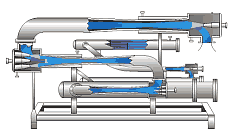
Croll-Reynolds vacuum system with surface type condensers
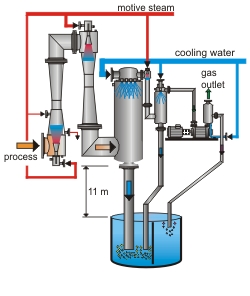
Körting: vacuum system with spray condensers, two stages without inter-condenser spray condensers with barometric legs 4th stage as a lquid ring vacuum pump