|
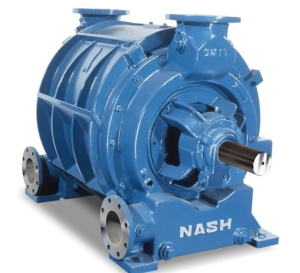
liquid ring vacuum pumps
applications advantages: - tolerate entrained liquids and solids - isothermal compression (for monomer recovery, explosive gases), - oilfree, - very safe for explosive gases, - simple design for corrosion resistant materials, disadvantages: - high power absorbed, - process fluid and auxiliary fluid are mixed-up / contaminated suction capacity: 10m³/h to 30.000m³/h vacuum: down to 30 mbarA
|
FAQ's - liquid ring vacuum pumps
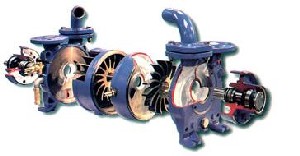
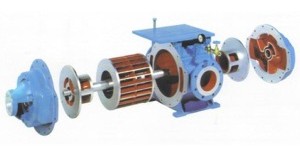
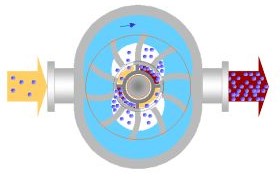
liquid ring vacuum pumps manufacturers Books about liquid ring technology Liquid ring patents more vacuum ? - use a colder liquid ring - use a sealant with a lower partial vapour pressure using water at 15°C as sealant (Partial Vapour Pressure = 17 mbar), the end vacuum will be around 25 mbar. with water at 35°C (PVP = 57 mbar), the end vacuum will be around 70 mbar. with ethylenglykol at 80°C (PVP=1 mbar), the end vacuum will be around 10 mbar. higher compression ratio ? for example if discharge pressure higher than atm. pressure. - increase tip speed, increase speed of rotation - use a double lobe pump, the ring will be more stable - use a two-stage pump, for less shaft deflection an introduction to gas removal systems and liquid ring vacuum pumps ABSTRACT Next to ejectors, Liquid-Ring Vacuum Pumps (LRVP) are the most used vacuum-producing devices in industry. Integration of Liquid-Ring Vacuum Pumps with Steam Jet Ejectors, commonly referred to as a hybrid system, is one of the more efficient methods of producing process vacuum. The LRVP is a specific form of rotary positive-displacement pump utilizing liquid as the principal element in gas compression. The compression is performed by a ring of liquid formed as a result of the relative eccentricity between the pump’s casing and a rotating multi-bladed impeller. The eccentricity results in near complete filling then partial emptying of each rotor chamber during every revolution. The filing-and-emptying action creates a piston action within each set of rotor of impeller blades. The pump’s components are positioned in such a manner as to admit gas when the rotor chamber is emptying the liquid, and then to allow the gas to discharge once compression is completed. Sealing areas between the inlet and discharge ports are provided, to close the rotor areas, and to separate the inlet and discharge flows. |