Film thickness monitoring     Vacuum coating systems (Equipment)     Vacuum coating (Services)


vacuum coating        vacuum coating


    Europe, Middle East and Africa     North and South America     Asia Pacific

     Germany     United Kingdom    


LewVac thin film thickness controller LewVac LLP - www.lewvac.co.uk - Unit F2, Ote Hall Farm, Burgess Hill, RH15 0SR, United Kingdom
E-Mail: sales@lewvac.co.uk, Tel. +44 (0)1444 233372, Fax +44 (0)1444 233392
products:
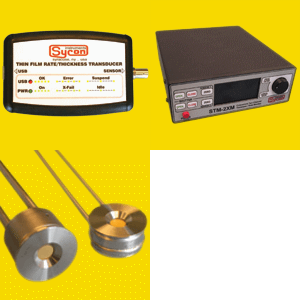
We are pleased to offer a broad range of quartz crystal sensor heads, deposition rate controllers and thickness rate monitors, along with all of the associated accessories. Sensors are available as standard models or can be easily tailored to suit your particular requirements.
company profile:
LewVac is a UK-based supplier of HV and UHV components to the vacuum technology market, with a product range of many thousands of quality components.
Our range of vacuum components is carefully selected from a broad base of manufacturers, enabling us to be competitively priced and to offer short lead times on standard products.


    Keywords     www.vacuum-guide.com     Sputtering sources     Sputtering targets


From Wikipedia - Thin-film thickness monitors
Thin-film thickness monitors, deposition rate controllers, are a family of instruments used in high and ultra-high vacuum systems. They can measure the thickness of a thin film, not only after it has been made, but while it is still being deposited, and some can control either the final thickness of the film, the rate at which it is deposited, or both. Not surprisingly, the devices which control some aspect of the process tend to be called controllers, and those that simply monitor the process tend to be called monitors.
Most such instruments use a quartz crystal microbalance as the sensor. Optical measurements are sometimes used; this may be especially appropriate if the film being deposited is part of a thin film optical device.
A thickness monitor measures how much material deposited on its sensor. Most deposition processes are at least somewhat directional. The sensor and the sample generally cannot be in the same direction from the deposition source (if they were, the one closer to the source would shadow the other), and may not even be at the same distance from it. Therefore, the rate at which the material is deposited on the sensor may not equal the rate at which it is deposited on the sample. The ratio of the two rates is sometimes called the "tooling factor". For careful work, the tooling factor should be checked by measuring the amount of material deposited on some samples after the fact and comparing it to what the thickness monitor measured. Fizeau interferometers are often used to do this. Many other techniques might be used, depending on the thickness and characteristics of the thin film, including surface profilers, ellipsometry, and scanning electron microscopy of cross-sections of the sample. Many thickness monitors and controllers allow tooling factors to be entered into the device before deposition begins.